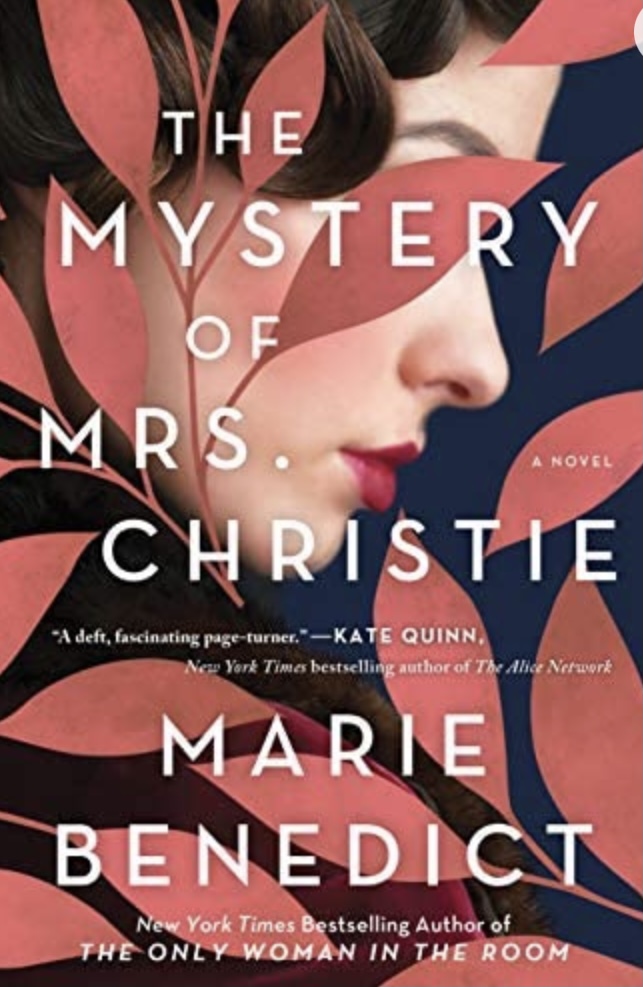
LET’S GET EXCITED ABOUT THIS BOOK!
Did you know that Agatha Christie, one of the most prolific mystery writers of all time, disappeared for 11 days in December of 1926? And did you know that to this day, no one knows why, how or what happened to Agatha Christie during those 11 days? And did you know that Agatha Christie herself never spoke about that time to anyone? What a mystery! In “The Mystery of Mrs. Christie,” Marie Benedict creates a very plausible scenario for these missing 11 days. She portrays a woman who has lost herself in an unhappy marriage and who must find a way to write herself into a new and happier life. Read my full review below and leave a comment to let me know your thoughts about the author’s interpretation of these mysterious 11 days!
Shannon’s Rating — PG-13
LET’S TALK ABOU THIS BOOK!
On December 4, 1926, Agatha Christie disappeared. Her car was found abandoned alongside a gloomy lake with a suitcase and fur coat left inside. For the next 11 days a massive manhunt is undertaken, and news of Christie’s disappearance makes headlines around the world. What transpired during those 11 days of searching played out like a mystery Christie could have written herself. It is estimated that between 10,000 and 15,000 people took part in the search for the author. Dozens of bloodhounds were brought in. Spiritualists held a séance by the side of the lake and declared that she had met with foul play. Papers reported that police had found clues such as opium, a bottle of poison, a box of face-powder and the end of a loaf of bread near her abandoned car. Sir Arthur Conan Doyle, creator of the famed detective, Sherlock Holmes, was even consulted on her case. Doyle had one of his psychic friends hold one of Christie’s gloves. He declared that the owner of the glove was not dead but was “half-dazed.” Adding to the mystery, Agatha Christie left behind three letters before she disappeared: one to her secretary, another to her brother-in-law and the third to her husband. Suspiciously, her husband refused to turn his letter over to the police, stating that it was a “personal note” with no bearing on the case or Christie’s disappearance.
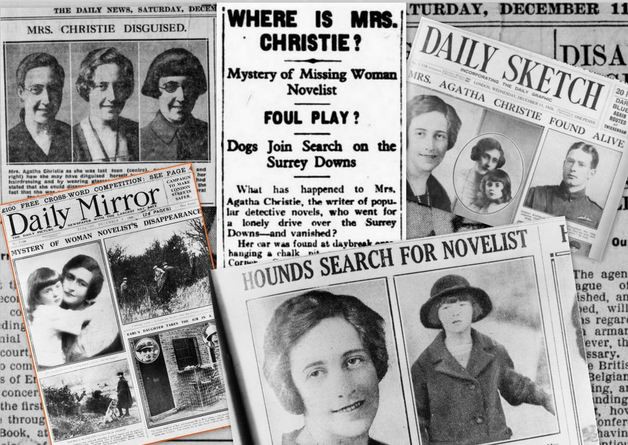

On December 14, Agatha Christie was discovered alive at a Yorkshire spa where she had been staying under an assumed name. The name, incidentally, that she had been using was the name of her husband’s mistress. When Archie showed up at the spa to retrieve his wife, it was reported that he was “welcomed by her with a stony stare.” He told the press that Agatha Christie suffered from amnesia and had no knowledge of who she was or what had happened during the time of her absence. For the rest of her life, Christie refused to talk about these 11 days. The mystery of what occurred during that time is still unsolved. It has fascinated and perplexed historians, biographers and Agatha Christie fans for over 90 years.
In “The Mystery of Mrs. Christie,” Marie Benedict imagines a possible scenario for these 11 days. I love when authors do this! When they take a little-known piece of history, or in this case an actual missing piece of history, and create a story around the event. I find it so fascinating!
Do you love to hate a character while reading a book or watching a movie? Well, if you do – buckle up! You will HATE Agatha Christie’s husband, Archie, in this book. I don’t remember when I’ve felt such angry feelings towards a character as I did towards this guy! The book alternates narratives back and forth between chapters. One chapter is narrated by Agatha (and takes us back in time to when she and her husband met) and one chapter is narrated by Archie (and starts on the day of the disappearance.) The alternating chapters continue back and forth until the conclusion of the novel.
The novel opens with Archie reading a letter Agatha left him on the night she disappeared. The letter states…
“How do you want this story to end? It seems to me that there are two paths from which you can choose, the first involving a softer landing than the second, though neither are without bumps and bruises, of course. These small injuries are simply a necessary consequence of this entire exercise, as I’m sure you must understand by now…Read on and follow my instructions closely if you wish the safety of the first path and the security of its conclusion…Only by following my directions at each crossroads in this journey will the story end well for us all.”
What follows is a story of a woman figuring out the mystery of herself and rising up from under an emotionally abusive husband. And it’s the story of an emotionally abusive husband finally getting his comeuppance! Towards the end of the novel, Agatha explains why her disappearance had to happen.
“I needed to create an unsolvable mystery in order to solve the mystery of myself.”
I will admit, I spent a great deal of this novel either angry at Archie or frustrated with Agatha. But the ending of the book changed all of that for me. I can’t go into more detail without giving away too much but just know, it has a very satisfying end!
The idea of an “unreliable narrator” is a prevalent theme throughout “The Mystery of Mrs. Christie.” An unreliable narrator is a narrator in a story who you ultimately can’t trust or who loses all their credibility. Agatha Christie used this technique in her novel, “The Murder of Roger Ackroyd,” where the doctor who narrated the book was actually the murderer. In “The Mystery of Mrs. Christie,” Agatha contemplated on the uses of unreliable narrators and thought, “It occurred to me that we are all unreliable narrators of our own lives, crafting stories about ourselves that omit unsavory truths and highlight our invented identities.” And then again at the conclusion of the novel Agatha wishes she would have been able to rewrite her story sooner. “But I wasn’t yet ready; I was still waiting for someone else to author my narrative, still hopeful that another ending was in store for me. Only when Archie killed that still-innocent woman did I finally accept that I had no other choice but to pick up the pen to save myself.”
I loved the idea of this novel that Agatha picked up a pen to save herself and paved the way to the kind of life that she deserved. While we’ll never really know what happened during those 11 days of Agatha Christie’s disappearance, I like to think that something like this author’s interpretation really occurred. How mysterious is it that one of the most famous mystery writers of all time has such a mystery surrounding her in real life??


 Shannon's Library
Leave a reply to Bryttin Jones Cancel reply