LET’S GET EXCITED ABOUT THIS BOOK!
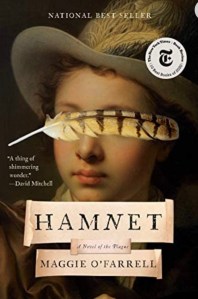
In the 1580’s, the name Hamnet was interchangeable with the name Hamlet. Did you know that? I did not! But now that I do, and after reading this novel, it entirely changes how I think about William Shakespeare and his play, “Hamlet.” This beautifully written novel explores grief and loss for a family in a touching and tender way. We learn about Shakespeare’s family life through the eyes of his wife, Agnes and his son, Hamnet. This was, by far, my favorite novel I read in 2021. This story will break your heart and then mend it again. After reading, “Hamnet,” and my full review – please leave a comment below and let me know your thoughts on this book! I’d love to hear them. This is a good one to talk about!
Shannon’s Rating – PG-13 (for some graphic depictions of the plague and heavy subject matters)
LET’S TALK ABOUT THIS BOOK!
Last year when everything shut down because of Covid, I remember thinking that it would be a great time to catch up on all the books I’d been wanting to read. Turns out, I wasn’t able to focus on certain types of books. Anything heavy or detailed or sad, I just couldn’t handle. So, for about a year, all I read was young adult fantasy novels. That was fun and all, but I reached a point where I was yearning to read something with a little bit more substance. A few months ago, I read “Hamnet,” by Maggie O’Farrell and it was everything I had been missing! If I had to describe “Hamnet” in just one sentence, it would be, “A beautifully written book on grief.” Now I know that doesn’t sound like much of a selling point for reading it. And like I said, a year ago wouldn’t have been the right time for me to read a book such as this. (Especially with all the descriptions of the plague!) But reading it right now was an experience I thoroughly enjoyed and appreciated.
One of my favorite writing techniques of an author is when he or she takes a little-known person or event in history and creates an imaginary world around a few historical details. Maggie O’Farrell has done just this with her book, “Hamnet.” I remember studying William Shakespeare in college and finding it intriguing that for a man who loved to write, there was shockingly little known about his everyday life. A few basic known facts about Shakespeare are that he married at the young age of 18 to a woman named Anne, who was 26. He had three children. His son, Hamnet, died at the age of 11 of unknown causes. That’s basically it. We have to fill in the blanks of Shakespeare’s family life with our imagination. History has not been kind to his wife, Anne. She’s perceived as a cougar-type of personality that ensnared young Shakespeare and tricked him into marriage. In “Hamnet,” Maggie O’Farrell imagines a different spin on Anne (known as Agnes in the book) and writes her as a unique and intriguing woman. A woman who quickly became one of my favorite written characters. She’s quirky, independent and a fiercely loyal, loving mother. I loved her! I went into this book thinking William Shakespeare would be the main subject. But he is actually a very minor character. In fact, he’s never even mentioned by name. You must read between the lines to even know he’s a part of the book. He’s referred to as; the tutor, the brother, the lad, the father, the husband, etc. To me, Agnes is the star of the novel and not having the name of William Shakespeare mentioned was a smart decision.
The historical note at the front of the novel really sets the stage for what’s to come in the following pages. “In the 1580’s a couple living on Henley Street, Stratford, had three children: Susanna, then Hamnet and Judith, who were twins. The boy, Hamnet, died in 1596. Four years or so later, the father wrote a play called Hamlet.” Apparently, the names Hamnet and Hamlet were interchangeable in the late 1500’s. I never knew that and I find it absolutely fascinating! How have I never known that Shakespeare named his play, “Hamlet,” and one of his most famous characters after his son who died as a young boy? (If I could insert the mind-blown emoji right here I would!)
The death of this young boy, Hamnet, is the driving force of the novel. I did my fair share of crying while reading this book, but it wasn’t overwhelmingly depressing or sad. Maggie O’Farrell somehow managed to write a book in which the death of a child is central to the story but it’s still beautiful and lovely. One of my favorite quotes comes shortly after Hamnet’s death when Agnes is still trying to process how suddenly one of her children is no longer there.
“She, like all mothers, constantly casts her thoughts, like fishing lines, towards her children, reminding herself of where they are, what they are doing, how they fare. From habit, while she sits there near the fireplace, some part of her mind is tabulating them and their whereabouts: Judith, upstairs. Susanna, next door. And Hamnet: Her unconscious mind casts, again and again, puzzled by the lack of bite, by the answer she keeps giving it: he is dead, he is gone. And Hamnet: The mind will ask again: At school, at play, out at the river? And Hamnet? And Hamnet? Where is he? Here, she tries to tell herself. Cold and lifeless, on this board, right in front of you. Look, here, see. And Hamnet? Where is he?”
Did you tear up while reading that? If so, you’re my kind of reader. I cry pretty easily when things are described so beautifully and yet so heart wrenching. Maybe this quote gets to me because I’m a mom of four children and my mind does exactly like Maggie O’Farrell describes. Multiple times a day I’ll think, where are my kids? Alex, at work. Meg, at school. Tess, at play practice. Ty, at a friend’s house. Check! I’m certain if I suddenly lost one of my children my mind would still be casting out fishing lines, reaching towards each of them and would be heartbroken when one of those fishing lines would now come back empty.
After reading this novel, I felt certain that Maggie O’Farrell must have suddenly and tragically lost someone she loved. How else would she be able to so accurately portray the feelings of each family member who experienced the loss of Hamnet? But O’Farrell, surprisingly, hasn’t ever lost anyone close to her. She is, however, a mother of a child with serious health issues. O’Farrell says she spends a lot of time imagining how she would feel and how she would react if something happened to her daughter. Knowing this makes it all the more incredible that she could so intuitively write about how each of the Shakespeare family reacted to Hamnet’s sudden death. The mother, the father, the older sister, the twin sister, the grandmother, the aunt, the uncle…each experienced and coped with Hamnet’s death differently and it was so fascinating to me to see how the author was able to convey that. My own family knows what it’s like to experience the unexpected and sudden loss of one of our members. My youngest sister passed away in a car accident at the age of 18. I think this is another reason I connected so passionately to this novel. I know how the sudden loss of my sister impacted my family and I could relate so closely to how the loss of Hamnet impacted the Shakespeare family. Another quote from the novel describes this loss so well…
“Agnes is a woman broken into pieces, crumbled and scattered around. She would not be surprised to look down, one of these days, and see a foot over in the corner, an arm left on the ground, a hand dropped on the flour. Her daughters are the same. Susanna’s face is set, her brows lowered in something like anger. Judith just cries, on and on, silently; the tears leak from her and will, it seems, never stop. How were they to know that Hamnet was the pin holding them together? That without him they would all fragment and fall apart, like a cup shattered on the floor?”
When a family loses a member, it can seem as if he or she was the pin holding the family together and now it’s broken and will never be the same. I think of it more like a family is a chain. Each member is an integral part of the family and when one is suddenly lost, the chain is broken. It can heal and be put back together with time, but it will never be the same length again. It will always be missing one certain link.
Looking back on what I’ve written, I’m worried I will have driven away more readers from this book than towards it. Hopefully, that is not the case. Sometimes it’s ok to not read a super happy and action-packed book. Sometimes it’s therapeutic to read a book about loss and see how different people cope with it. Sometimes it’s ok to break and to cry while reading a book. I’m a big believer that books like this are important and worthwhile. So we read them, we digest them, we learn from them…and then we go pick up another fun, fantasy novel for our next read!

 Shannon's Library
Leave a comment